
TORTURE EXISTS IN 2018 IN THE US AND IT IS SPREADING GLOBALLY. IT’S HAPPENING IN MEDICAL FACILITIES. IT’S HAPPENING TO CHRONIC PAIN PATIENTS (CPP), PEOPLE WHO ARE RECOVERING FROM SURGERY AND TRAUMATIC INJURY AND PEOPLE WITH PAINFUL,  INCURABLE DISEASES. THE GENERAL ASSEMBLY OF THE UNITED NATIONS HAS GONE ON RECORD STATING THAT, “UNTREATED PAIN IS TANTAMOUNT TO TORTURE OR CRUEL, INHUMAN OR DEGRADING TREATMENT OR PUNISHMENT.” [1] BY DENYING PAIN CONTROL TO PATIENTS WITH ACUTE OR CHRONIC PAIN, WE ARE LOSING A BASIC HUMAN RIGHTS ISSUE.
Now is the time for us ALL to UNITE and take ACTION!
 “Opioid Crisis” is a new buzz term being overused by national news and government officials to evoke a negative feeling about a drug that was created for helping people. The definition of “crisis” by Merriam-Webster dictionary is partially defined as “an unstable or crucial time or state of affairs in which a decisive change is impending; especially: one with the distinct possibility of a highly undesirable outcome.”
There is much ignorance from our government officials. One example is from the US Attorney General, Jeff Sessions. In a visit to Tampa in February, Sessions remarked, “I am operating on the assumption that this country prescribes too many opioids. People need to take an aspirin sometimes and tough it out a little.”[2] This statement underlies the lack of understanding of chronic pain and its detrimental effects among the government officials who have been tasked with solving this opioid crisis.
President Trump made this comment on March 19, 2018 and was quoted in an article by NPR: “Whether you are a dealer or doctor or trafficker or a manufacturer, if you break the law and illegally peddle these deadly poisons, we will find you, we will arrest you, and we will hold you accountable.”[3] While he is attacking the problem in multiple ways, he still seems to want to go after the legal prescription side in this battle.
Sixteen senators (now 15, since Al Franken resigned) had approached the DEA and requested and received a 20% cut in production in legal opioids in 2018 after cuts in 2017, and they want more cuts in 2019. Less production of legal meds creates big problems. And the DEA and Sessions have responded to this request, proposing a new rule that would allow the DEA to reduce the amount of opioids that drug companies can manufacture and sell, if it believes that a company’s opioids are being diverted for misuse.[4] Meanwhile, hospitals are already experiencing a shortage of many injectable opioids used for surgical anesthesia and for the treatment of post-surgical, traumatic and disease-produced severe pain.[5]
There have been a lot of statistics used to sway opinions in this fight. A group of anti-prescription opioid zealots known as PROP (Physicians for Responsible Opioid Prescribing) have made claims about prescription opioids that most patients and doctors alike would disagree with. Members of PROP, including Andrew Kolodny, MD, an addiction specialist who serves as PROP’s executive director, have been very influential in the media and with government bodies alike. They were very involved with the formation of the 2016 CDC Opioid Prescribing Guidelines. In a 2015 Q&A for the Kolmac Outpatient Recovery Center, Kolodny said, “Many Americans are truly convinced that opioids are helping them. They can’t get out of bed without them.”[6] And in an interview with The Fix in 2016, Kolodny was quoted as saying “Heroin users will use some of the exact same language pain patients use to explain how opioids help them. They wake up and feel agonizing pain, and they take their opioid and their pain becomes bearable.”[7] While PROP and its members are busy trying to convince the public and the US government that opioids are almost never appropriate for chronic pain and that patients who use long-term prescribed opioid therapy are tantamount to addicts, the science seems to disagree. In a recent white paper published by the Alliance for the Treatment of Intractable Pain, a review of the applicable research laid out the case for opioid prescriptions for chronic pain being both effective and posing a very low risk for addiction.[8]
In addition, the Centers for Disease Control (CDC) continued to count all deaths with legal or illegal opioids in a body, as an opioid death and using these statistics as an impetus to develop their 2016 guidelines, as well as listing them on their website to be cited by the media and other government officials who were tasked with developing policies to curb the overdose crisis. Using these statistics, it is no wonder that government officials came away with a belief that prescribing fueled the overdose crisis. However, in an article in April 2018 in a publication of the American Public Health Association, four CDC officials quietly admitted that the CDC statistics were miscalculated, and over-inflated by about double.[9] So far, the CDC itself has not officially admitted that the numbers are wrong, and continue to stand by their 2016 prescribing guidelines.
The PDMP (Prescription Drug Monitoring Program) was an answer government officials put in place to ensure that legal drug users were brought into compliance with the new standards being enforced on doctors and pharmacies. The legal prescription opioid users that still have access to pain medication sign contracts, subject themselves to random drug testing and agree to use one pharmacy. Well, the reduction in production of opioids in 2018 has caused many pharmacies to have a drug shortage. Many pharmacists are also reticent to fill opioid prescriptions out of fear of the DEA, or worry about fueling the opioid crisis because of the false media narrative. Pain patients drive to the doctor’s office to pick up their paper prescription, take it to their pharmacy and wait. If that pharmacy is out of your medication, you now go to another pharmacy and this trend continues in hopes of a refill. Then we need to call our doctor’s office back and let them know we filled our prescription at another location. This is a lot on people with chronic pain.
 There is also a negative stigma attached to having to take pain meds. Many chronic pain patients take prescription opioids to continue meaningful work. This could be a huge problem because they are afraid to speak out, afraid of losing their job, or at least bringing suspicion upon themselves from employers. Many patients are afraid that if those around them know they take pain medication, they will be seen as addicts. But it is time to brush off the stigma and the fear and to stand up for our rights to access proper and effective medical treatment. If we don’t, we may lose access permanently and keeping our jobs, social lives, and other important activities and relationships will not be possible due to disability from pain.
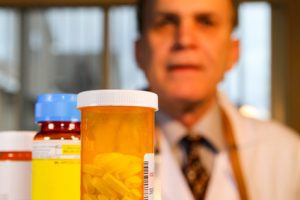 Doctors that want to be doctors are now caught up wasting time in government “guidelines” or laws and pressure from insurance companies that do not want to cover pain control prescribed by our doctors. Many doctors who have continued to prescribe despite the current hostile regulatory environment have been threatened, raided, and even arrested by the DEA.[10] Our doctors are having to choose between upholding the Hippocratic Oath and keeping their ability to practice medicine and earn a livelihood altogether.
On April 3, 2018, the Centers for Medicare and Medicaid Services adopted a new policy governing opioid prescriptions for Medicare patients. While they backed down from a proposed “hard limit” where opioid prescriptions above 90 mg MME would be rejected at the pharmacy and could only be overridden by the insurer, they did end up passing a 200mg MME hard limit, and a “soft edit” at the 90 mg MME mark. This requires pharmacists to speak with the prescribing physician about the appropriateness of the dose for all prescriptions above 90MME. The pharmacist must then document this conversation and may fill the prescription at their discretion. The new rule also limits all new opioid prescriptions to 7 days, meaning Medicare will no longer pay for new opioid prescriptions that last more than 7 days, regardless of the circumstances. Many Chiari and EDS patients undergoing major surgery such as decompression or fusion, will no longer be able to receive more than a week of post-surgical pain medication without returning to their doctors for a new prescription. And patients who develop severe chronic pain in the future may not be able to get appropriate treatment for their pain. The only thing that kept CMS’ original proposal of a hard limit at 90mg MME was a severe backlash resulting in hundreds of strongly worded comments on their public docket from patients and physicians alike.[11] It is proof that our voices do matter and that we can make a difference when we speak out.
Despite some backlash from the chronic pain and medical communities, the government pushes forward with their agenda. Some states have lost their right to proper pain control and many are being threatened. It is time for those patients who have been sitting on the sidelines waiting for someone else to fight this battle for them, to rise and make some noise. It’s time for ALL of us to unite to make changes for ourselves and the future Pain Patients and our children. Imagine our children, inheriting these conditions from us and suffering the same or worse pain as we do, and having zero access to effective pain treatment because we allowed our government to take away one of our most effective treatment options!
What we all need to do is contact our elected officials. It easy to type up your email regarding your story and what pain meds mean to you or loved ones. You can look up your elected officials email address and copy and paste your email and send to many people. The elected official I spoke with said they have not heard from Chronic Pain Patients. Please take time and do this. You can send out emails laying down from your bed. You can also follow our CALL TO ACTION posts, which will inform you of key legislation and administrative actions and how you can act to make sure that our voices are heard.
My voice is one, but if many are sent in, they might listen. There is strength in numbers and together, we CAN make a difference! Please help.
[wpedon id=”4396″ align=”center”]
References:
1 Tennant, Forest. “Editor’s Memo October 2017: United Nations Says Untreated Pain Is ‘Inhumane and Cruel.’” Practical Pain Management, PracticalPainManagement, <www.practicalpainmanagement.com/treatments/pharmacological/opioids/united-nations-says-untreated-pain-inhumane-cruel>.
2Slattery, Denis. “AG Sessions Says Patients Should Take Aspirin or Suffer through Pain to Prevent Opioid Addiction – NY Daily News.” Nydailynews.com, New York Daily News, 8 Feb. 2018, <www.nydailynews.com/news/national/sessions-patients-aspirin-fight-opioid-crisis-article-1.3808114>.
3Horsley, Scott. “President Trump Vows To ‘Liberate’ U.S. From Opioid Crisis.” NPR, NPR, 19 Mar. 2018, <www.npr.org/2018/03/19/594999711/president-trump-vows-to-liberate-u-s-from-opioid-crisis>.
4Anson, Pat. “Sessions Wants More Cuts in Opioid Production.” Pain News Network, 17 Apr. 2018, <www.painnewsnetwork.org/stories/2018/4/17/sessions-wants-more-cuts-in-opioid-production>.
5 Bartolone, Pauline. “The Other Opioid Crisis: Hospitals Are Running Short of Powerful Painkillers.” Los Angeles Times, Los Angeles Times, 16 Mar. 2018, <www.latimes.com/business/la-fi-opioid-painkiller-hospitals-20180316-story.html#nws=mcnewsletter>.
6 Kolodner, George. “Q&A: Dr. Andrew Kolodney, Chief Medical Officer, Phoenix House.”Kolmac Outpatient Recovery Centers, 14 Dec. 2015, <www.kolmac.com/2015/12/qa-dr-andrew-kolodny-chief-medical-officer-phoenix-house/>.
7Siegel, Zachary. “Pain Patients Fear the Future Amid Opioid Crisis.” The Fix, 27 Nov. 2018, <www.thefix.com/pain-patients-fear-future-amid-opioid-crisis>.
8Lawhern, Richard A. “Prescription Opioids and Chronic Pain.” The Alliance for the Treatment of Intractable Pain, Mar. 2018, <www.atipusa.org/2018/04/02/atip-white-paper-on-prescription-opioids-and-chronic-pain/>.
9Seth, Puja, et al. “Quantifying the Epidemic of Prescription Opioid Overdose Deaths.”American Journal of Public Health, 7 Mar. 2018, <www.ajph.aphapublications.org/doi/10.2105/AJPH.2017.304265>.
10Bernstein, Lenny. “DEA’s Opioid Crackdown Brings Arrests of Prescribers, Pharmacists.” The Washington Post, WP Company, 2 Apr. 2018, <www.washingtonpost.com/national/health-science/deas-opioid-crackdown-brings-arrests-of-prescribers-pharmacists/2018/04/02/64ded32a-368f-11e8-8fd2-49fe3c675a89_story.html?noredirect=on&utm_term=.ef5781020422>.
11Roubein, Rachel. “CMS Tweaks Opioid Proposal after Backlash.” TheHill, The Hill, 3 Apr. 2018, <www.thehill.com/policy/healthcare/381493-cms-tweaks-opioid-proposal-after-sparking-backlash>.

 MAINTAIN A POSITIVE ATTITUDE:
 CHOOSING FOODS WITH YOU IN MIND:
 MOVING IS ESSENTIAL TO MOBILITY:

 Chronic pain is something Chiarians face on a daily basis. Disabling pain that reduces your quality of life can make once simple tasks difficult to accomplish. Things like taking a shower or cooking become incredibly challenging. Fatigue can set in quickly, that even when we have plans that we’re excited about, just getting ready for them can be enough to put us back in bed. All of this can give us an altered self-perception of feeling useless, which enhances the depression. Chronic pain is both a physical and psychological condition, thus making treatment complex and difficult. Pain can cause depression and depression causes pain; it’s a vicious cycle.
 Adjusting to the new normal is always a challenge, not only for us, but the ones we love as well. The loss of our former selves and our careers is very hard. Maybe you were a full-time parent or provider, caring for your family and you find yourself the one being cared for by loved ones. You find yourself depending on family and friends to do for you things that you once did for yourself, making you feel like a burden on those you love most. You may experience a sense of helplessness when trying to get friends and family to understand what you are going through. There will be friends and family who cannot or will not try to understand. They will think you are lazy or seeking attention. We must mourn the loss of old selves, careers, sometimes family and friends, as others must mourn their loss of your former self, and learn to embrace the new you in your new normal.