
When “Safe and Effective” Fails: Fluoroquinolones and the Erosion of Public Trust


For decades, patients seeking medical care trusted a simple, foundational principle of medicine: First, do no harm. When a doctor handed down a prescription, patients assumed the medication had been thoroughly vetted for safety. Adverse reactions were presented as statistically negligible cases—unintended side effects in the march of modern medical progress.
Yet for millions of patients, especially those living with connective tissue disorders like Hypermobile Ehlers-Danlos Syndrome (hEDS) or Chiari Malformation, that trust has been shattered.
The history of fluoroquinolone antibiotics stands as a stark case study in institutional failure. Marketed for decades as routine frontline treatments, these powerful drugs were later retroactively hit with severe Black Box warnings. This story reveals a deeper crisis: the ongoing breakdown of public faith in corporate medicine.
The Rise of Fluoroquinolones: Profit Over Caution
Introduced widely in the 1980s and 1990s, fluoroquinolones were hailed as broad-spectrum miracle drugs. The class includes well-known medications like Ciprofloxacin (Cipro), Levofloxacin (Levaquin), and Moxifloxacin (Avelox). They were fast-acting, effective, and convenient.
Driven by aggressive pharmaceutical marketing, doctors routinely prescribed them for minor, uncomplicated issues: sinus infections, mild UTIs, bronchitis, and ear infections. Millions of prescriptions were written every year.
Behind the scenes, however, a troubling reality emerged. Early clinical trials—often funded and designed by the drug manufacturers themselves—were never structured to catch delayed, long-term, or multi-systemic damage. As these drugs dominated the market, reports of life-altering side effects began piling up in patient communities around the world.
A History of Withdrawals and Delayed Warnings
For years, regulatory agencies insisted that severe reactions were statistically negligible. Yet the safety history of fluoroquinolones tells a different story—one marked by sudden market withdrawals and late, reactive warnings.
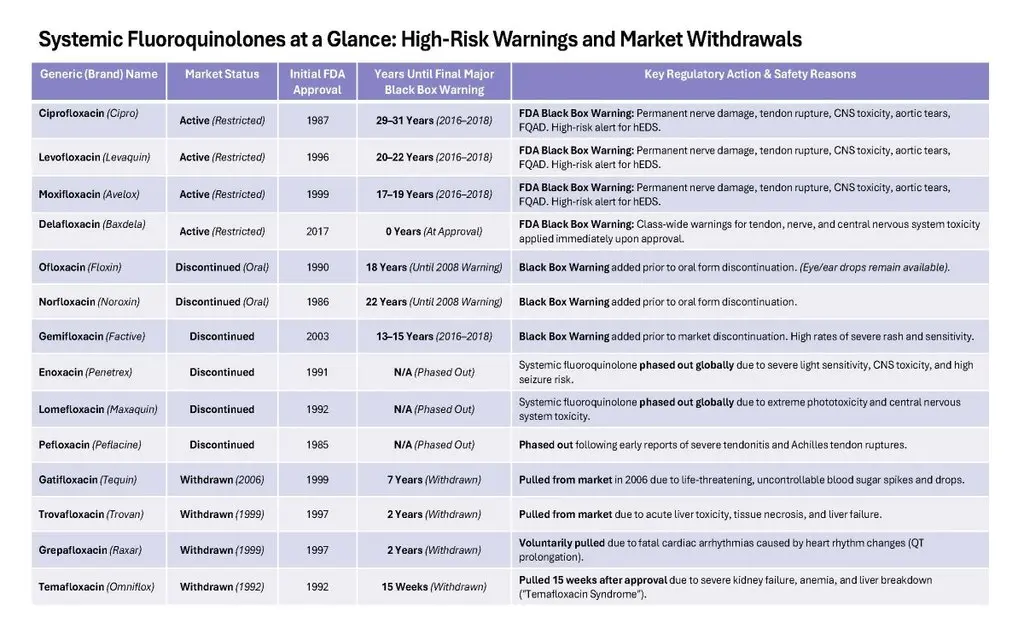
Decades to Acknowledge the Damage
Decades of fierce patient advocacy, ruined lives, and overwhelming real-world evidence were needed for the FDA to intervene. Between 2008 and 2018, the agency issued a series of increasingly severe Black Box warnings—the strongest safety alert short of a total ban:
- 2008: Warning added for an increased risk of severe tendinitis and tendon rupture.
- 2013: Warning updated to explicitly state that nerve damage (peripheral neuropathy) can happen rapidly and become permanent.
- 2016: The FDA stated that for simple infections (like sinus or mild bladder infections), the risks of fluoroquinolones outweigh the benefits, advising doctors to use them strictly as a last resort.
- 2018: Warning issued specifically for high-risk populations—including individuals with Ehlers-Danlos Syndrome, hypermobility, or aortic aneurysms—due to the risk of aortic tears, tissue breakdown, and permanent disability.
The Hidden Peril for hEDS and Chiari Patients
For patients living with Hypermobile Ehlers-Danlos Syndrome (hEDS) or structural conditions like Chiari Malformation, these delayed warnings came at a devastating cost.
hEDS is a connective tissue disorder caused by defective collagen. Collagen is the physical scaffolding that holds together tendons, ligaments, blood vessels, and fascia throughout the body.
Fluoroquinolones interfere with collagen production and break down connective tissue. Giving a collagen-degrading antibiotic to a person whose body already struggles with fragile collagen is a dangerous combination. The result is often Fluoroquinolone-Associated Disability (FQAD)—a severe syndrome marked by widespread joint damage, tendon tears, burning nerve pain, and profound loss of mobility.
To make matters worse, patients who experienced these sudden post-antibiotic breakdowns were routinely dismissed. Because standard bloodwork and imaging rarely catch subtle cellular damage, patients were gaslit, told their symptoms were “just anxiety,” or referred to mental health providers. They were left to suffer both physical destruction and severe medical trauma.
How Medical Hegemony Shattered Public Trust
The tragedy of fluoroquinolones is not an isolated mistake or a single company’s oversight. It reveals a repeating pattern within modern healthcare:
- Declarations of Safety: A pharmaceutical product is launched, backed by industry-sponsored trials, and declared safe and necessary for broad populations.
- Suppression of Early Warnings: Patients and independent clinicians who raise early alarms about side effects are ignored, dismissed as “anecdotal,” or accused of spreading misinformation.
- A Slow, Reluctant Retreat: Years or decades later—after thousands of lives have been disrupted—institutions quietly update labels, attach Black Box warnings, or pull drugs off shelves, rarely acknowledging the damage done.
- The Informed Consent Loophole: Even after Black Box warnings are issued, doctors are not legally required to verbally inform patients of these warnings before handing down a prescription. Patients are left to discover the risks on their own—often only after irreversible harm has already occurred.
When public health institutions demand uncritical trust while enforcing rigid corporate consensus, they destroy the foundation of real science: open debate, continuous reassessment, and listening to patient outcomes.
When guidance shifts from “safe and routine” to “risk of permanent disability”—and patients are kept in the dark at the exam table—public skepticism is not irrational. It is a logical tool for self-preservation. Patients can no longer afford to blindly trust institutions or providers that prioritize commercial convenience over genuine patient safety.
What You Can Do to Protect Yourself
If you or a loved one live with hEDS, hypermobility, or any connective tissue disorder:
- Always Disclose Your Diagnosis: Make sure every doctor, surgeon, and pharmacist knows you have a connective tissue condition before you accept any new prescription.
- Ask for Alternatives: Unless you face a life-threatening infection with no other option, request a safer, non-fluoroquinolone antibiotic.
- Listen to Your Body: If a medication causes sudden, burning nerve pain, joint stiffness, or extreme weakness, seek medical evaluation immediately and advocate for your safety.
Science is an ongoing process of testing, learning, and refining—not an unquestionable doctrine. By speaking up, sharing real experiences, and demanding accountability, patients are leading the way toward a safer medical system.
Reclaiming Informed Consent
Real progress in medicine will not come from top-down decrees or silencing debate. It comes from empowered patients, transparent science, and true informed consent.
Surviving Chiari Malformation, tethered cord syndrome, and FQAD taught Michelle Nieves that staying silent is not an option. Her journey exposes why independent advocacy like Chiari Bridges is indispensable—it pushes back against dogmatic diagnostic criteria, shines a light on undocumented drug toxicities, and demands that medical institutions prioritize real-world patient outcomes over corporate consensus. Read her story, “The Michelle Nieves Story – Reclaiming My Voice: hEDS, Chiari, and the Hidden Dangers of Fluoroquinolones.”

0 comments